
STAIRLIFTS
Stairlifts: Choosing the Right Lift for Your Home
A stairlift can make it easier and safer to move between floors when stairs become difficult. This guide explains straight, curved and outdoor options, what to consider before buying, typical costs and how to find providers who serve your area.
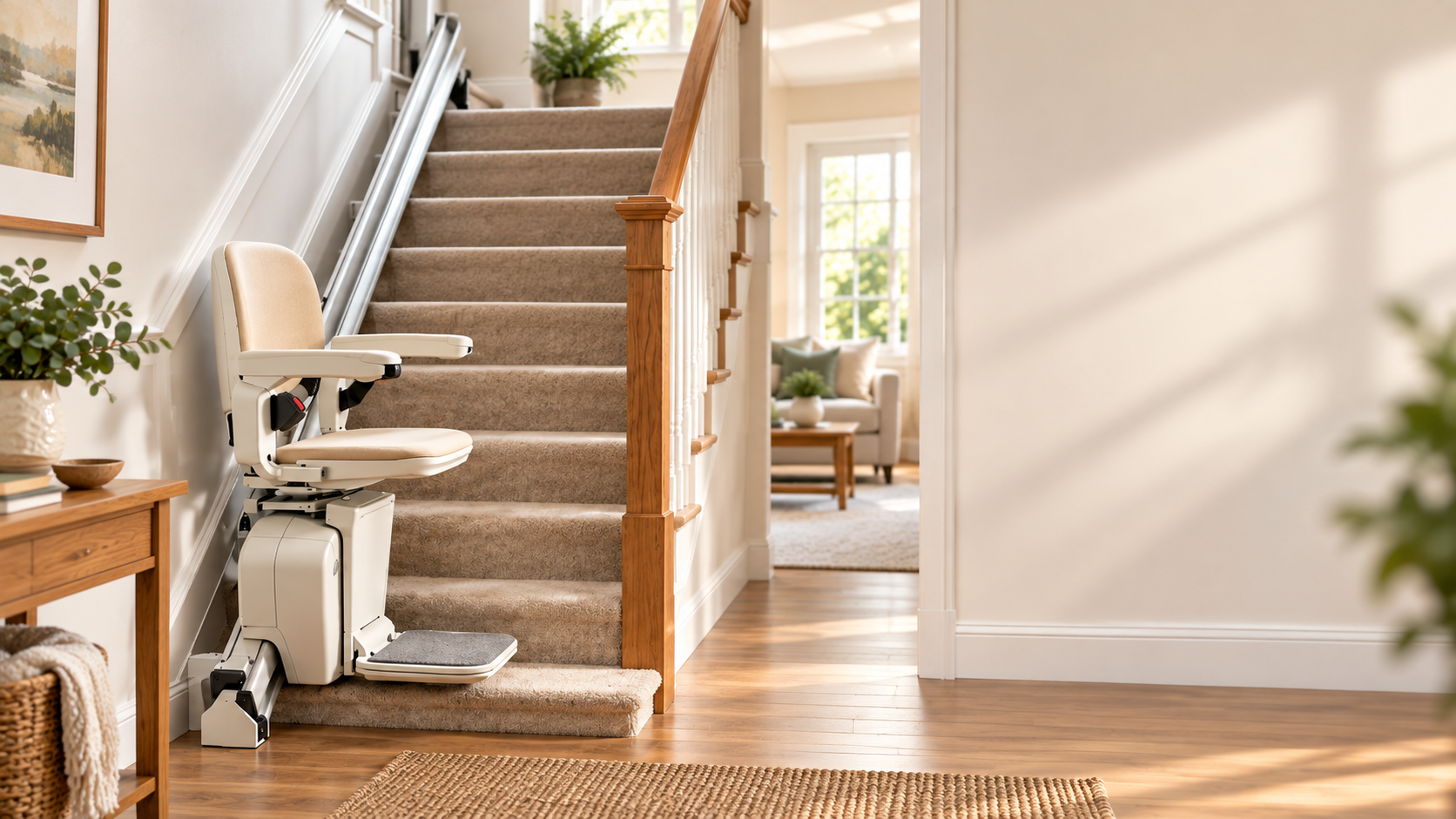
Stairlifts can help someone continue using more of their home when climbing stairs becomes difficult, tiring or unsafe. The right solution depends on both the staircase and the person using it.
Before choosing a model, consider the shape of the staircase, whether the person can transfer safely onto and off the chair, the space available at each landing, and whether another home modification or professional assessment may be more appropriate.
May be suitable for
Someone who finds stairs difficult but can usually transfer safely onto and off a seated lift.
Main options
Straight, curved and outdoor stairlifts; rental and reconditioned equipment may be available.
Typical 2026 installed costs
Straight: $2,000–$9,000. Curved: around $9,000–$25,000+.
Financial help
Original Medicare does not generally cover stairway elevators; other programs may help eligible households.
On this pageIs a stairlift right for me?Types of stairliftWhat to check in your homeSafety and installationCostsPaying for a stairliftChoosing a providerFind providers
Is a stairlift right for me?
A stairlift can be a practical option when the main difficulty is getting safely between floors and the person using it can sit securely and transfer onto and off the chair. It may be useful when moving the bedroom or bathroom downstairs is impractical, the rest of the home remains suitable, or climbing the stairs has become increasingly difficult because of reduced strength, pain, breathlessness or mobility.
A stairlift is not automatically the right answer simply because stairs have become difficult. The person’s ability to transfer, balance, understand and operate the controls, position themselves safely and get off at both ends all matter.
A stairlift may be suitable when…
- The main difficulty is travelling safely between floors.
- The person can sit securely and transfer on and off the chair.
- The rest of the home remains suitable for day-to-day living.
- A practical alternative to moving or major renovation is wanted.
Consider an assessment first when…
There is uncertainty about safe transfers; there have been repeated or unexplained falls; balance, vision or cognition may affect safe use; mobility is changing quickly; the person normally remains in a wheelchair; or several areas of the home present accessibility problems.
An occupational therapist can assess the interaction between a person’s abilities, daily activities and home environment, and may recommend a stairlift, another modification, equipment or a combination of measures.
Explore Occupational Therapy Home Assessments
Explore Home Safety Assessments
What types of stairlift are available?
Straight stairlifts
Designed for a staircase that runs in a single straight line without turns or intermediate landings. The rail does not normally need to be custom-made around bends, so these tend to be the simplest and least expensive type.
A folding rail may still be needed where the bottom of the staircase crosses a hallway or doorway.
Curved stairlifts
Use a rail designed around the individual staircase. They can accommodate bends, corners, intermediate landings and complex layouts.
The custom rail is why these usually cost more. For several straight flights, ask whether one curved system or more than one straight system is the better practical option.
Outdoor stairlifts
Can be installed on suitable exterior steps to entrances, gardens, porches or other levels. Discuss rain, heat, cold, snow, coastal conditions, covers, drainage, maintenance and environmental limits with the provider.
Rental and reconditioned stairlifts
Rental can make sense where a stairlift is needed for a limited period, particularly on a simple straight staircase. Reconditioned equipment can reduce the initial cost, but ask what has been replaced or tested, the warranty provided, whether the rail is new or reused, and whether parts and servicing will remain available. Curved rails are usually made for a particular staircase, making rental and reuse less straightforward.
What about wheelchair platform lifts?
A seated stairlift requires the user to transfer onto the chair. Someone who needs to remain in their wheelchair may require a platform lift, vertical platform lift, ramp or another accessibility solution instead. These are different products with different space, structural and installation requirements.
What should be checked in the home?
Choosing a stairlift is partly about the equipment and partly about whether the staircase and surrounding space work safely for the person using it.
Staircase shape and width
The survey needs the length, angle and shape of the staircase, turns, landings, unusual steps and obstructions. There must be enough usable width for others once the rail and folded chair are installed.
Space at the top and bottom
Check how the seat stops, whether it can swivel for a safer transfer, nearby door conflicts and enough stable space to stand, turn or use a walking aid.
Other people using the stairs
Consider children, visitors and household members using the stairs on foot. Folding seats, footrests and rails may matter where space is limited.
User size, posture and mobility
Stairlifts have weight limits and seat dimensions. Discuss seat height, armrests, belt, footrest, swivel arrangement and capacity—not simply the model that fits the stairs.
Power and charging
Many operate from rechargeable batteries charged from household electricity. Ask how charging works, what happens in an outage, how battery condition is monitored and what to do if the chair stops away from its normal parking position.
Stairlift safety and installation
A stairlift should be treated as installed mobility equipment, not simply as furniture. A professional survey and installation helps confirm secure mounting, rail alignment, clearances, electrical requirements and the operation of safety features. Exact codes, permits and inspections can vary by state and local jurisdiction; a provider should explain what applies at your property and who is responsible.
ASME A18.1-2023
Safety Standard for Platform Lifts and Stairway Chairlifts. This national standard covers areas including design, construction, installation, operation, inspection, testing, maintenance and repair.
A stairlift does not replace wider stair safety
Installing a stairlift does not mean the staircase itself can be ignored. National Institute on Aging and CDC guidance recommends secure handrails, good lighting, clear walking areas and attention to slipping or tripping hazards. These remain relevant for other household members and for the stairlift user whenever they approach, leave or move around the staircase.
National Institute on Aging: fall prevention · CDC: older adult falls
How much does a stairlift cost in 2026?
There is no single national stairlift price because the staircase, rail, equipment and installation all affect the total. These are indicative 2026 market estimates, not quotations; prices vary significantly by location and provider.
| Type | Indicative 2026 range | Why the price varies |
|---|---|---|
| Straight stairlift | $2,000–$9,000 | Stair length, model, seat, folding rail, capacity and optional features. |
| Curved stairlift | Around $9,000–$25,000+ | Custom rail, bends, landings, staircase length and specification. |
| Outdoor stairlift | Around $4,000–$25,000 | Weather-resistant construction, layout, length and customization. |
| Reconditioned straight lift | Often lower than new | Equipment condition, warranty, compatible rail and installation. |
Why curved stairlifts cost more
A straight lift can normally use a standard straight rail cut to length. A curved staircase usually requires a rail measured and manufactured for the individual property; turns, longer stairs and complex landings increase material and engineering.
Compare the total installed price
Two quotations that appear similar may include different things. Check whether the price includes the home survey, stairlift and rail, delivery, installation, electrical work if required, permits or inspection, user demonstration, warranty, servicing, call-outs and eventual removal costs. Do not assume an unusually low equipment price is the final installed cost.
Can Medicare, Medicaid or other programs help pay for a stairlift?
Financial help is possible in some circumstances, but there is no single nationwide stairlift funding program. Eligibility depends on the program, disability or care needs, location and proposed modification.
Original Medicare
Original Medicare does not generally cover a stairlift as durable medical equipment. CMS’s Durable Medical Equipment Reference List identifies stairway elevators as denied because they do not meet Medicare’s DME definition. A medically necessary occupational therapy assessment may be billable in some circumstances even though the stairlift itself is not covered.
Medicaid and Home and Community-Based Services
Medicaid rules differ by state. Federal HCBS frameworks allow states to offer environmental modifications or home accessibility adaptations, but the existence of a program does not mean every stairlift is covered. Ask about eligibility, approved modifications, assessment requirements, spending limits and whether authorization is needed before work begins.
Help for Veterans
VA programs need careful distinction. HISA specifically lists stair glides among excluded items, so it should not be assumed to pay for a stairlift. Separately, qualifying Veterans and Servicemembers with certain permanent and total service-connected disabilities may be eligible for adapted-housing grants; eligibility is specific, so contact VA before ordering.
State and local support
Some communities offer home-modification, accessibility, aging-in-place or low-income repair programs through state agencies, local government, nonprofits or aging-services networks. Your local Area Agency on Aging may help identify resources; availability and eligibility vary locally.
How to choose a stairlift provider
A good provider should assess both the staircase and how the proposed equipment will actually be used. Before agreeing to an installation, consider asking:
- Who will survey and install the stairlift, and are they trained or authorized for the equipment?
- Which model is recommended and why is it appropriate for this staircase and user?
- What is the total installed price, and what is not included?
- Are permits or inspections required locally, and who arranges them?
- What safety features are included as standard?
- How does the lift operate during a power failure?
- What warranty covers the equipment, rail and installation?
- Who provides servicing and emergency repairs, and how quickly are call-outs normally handled?
- If reconditioned, what was inspected or replaced and what warranty applies?
- What happens if it is no longer needed, including removal, rental cancellation or buy-back?
Where possible, compare more than one proposal and make sure quotations describe the same scope of work.
TAKE THE NEXT STEP
Find stairlift providers that serve your ZIP
When you are ready to speak with providers, AIPUSA can help you find stairlift businesses whose declared service coverage includes your area—rather than simply displaying the closest office.
Sources and review
This guide uses information from the Centers for Medicare & Medicaid Services, Medicaid.gov, U.S. Department of Veterans Affairs, Administration for Community Living, National Institute on Aging, CDC, American Society of Mechanical Engineers and American Occupational Therapy Association. Indicative 2026 costs were cross-checked against Angi and HomeAdvisor consumer cost data.
Content reviewed: September 2026
Funding rules, eligibility, prices, standards and local requirements can change. Check current requirements with the relevant agency, program or provider before committing to work.
AIPUSA provides general consumer guidance and does not replace medical, occupational therapy, engineering or other professional advice. If safe transfers, balance, cognition or suitability are uncertain, consider an appropriate professional assessment before purchasing equipment.