
GRAB BARS & HANDRAILS
Grab Bars & Handrails: Safer Support Around Your Home
Grab bars and handrails can provide extra support in bathrooms, on stairs and around entrances where balance, transfers or steps have become difficult. This guide explains where they can help, installation considerations, typical costs, possible funding routes and how to find providers who serve your area.
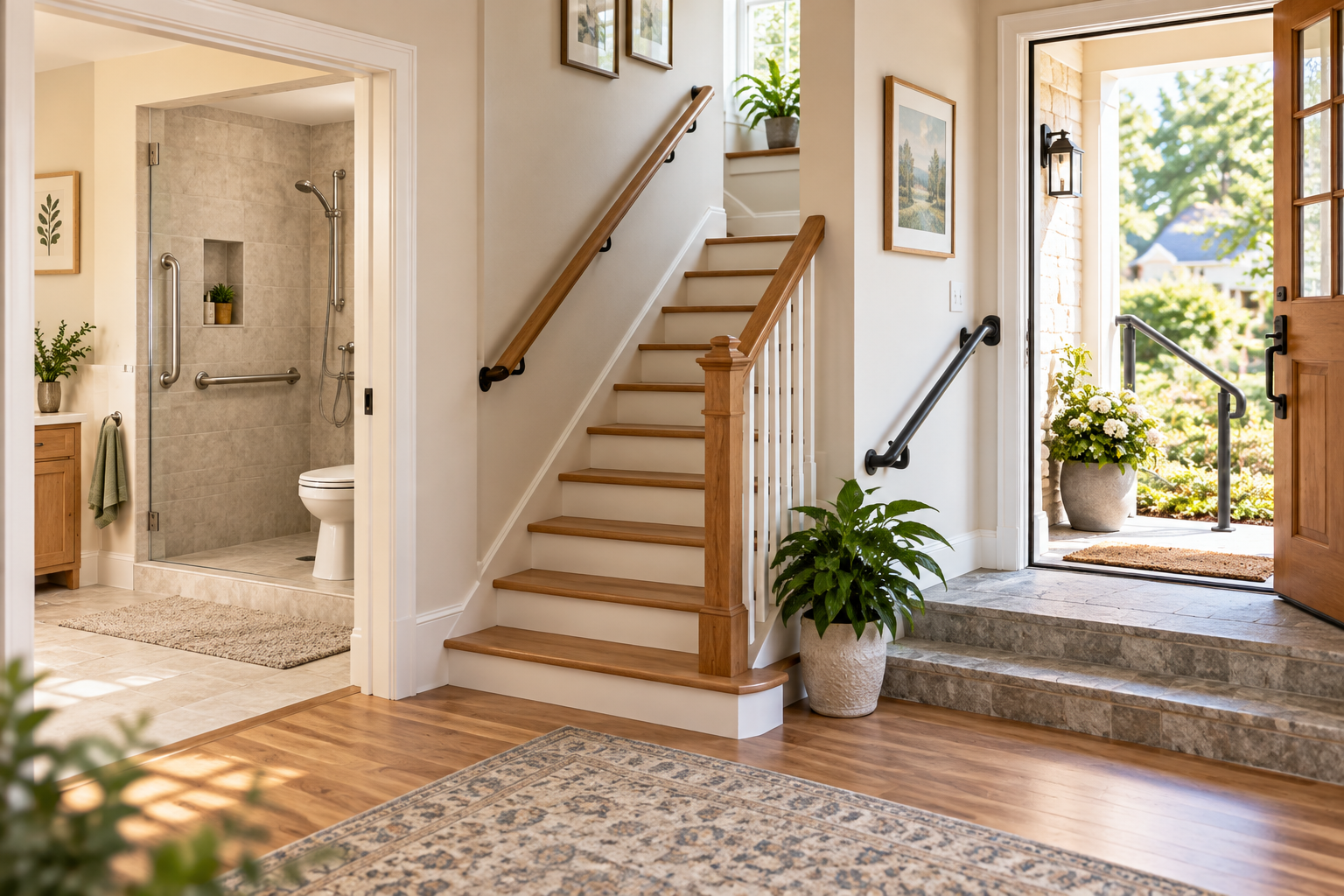
Grab bars and handrails are relatively simple home modifications, but where and how they are installed matters. A securely fitted support in the right place can help with standing, transferring, stepping or climbing stairs; a poorly positioned or inadequately fixed one may provide little useful support.
The right solution depends on the movement being supported, the structure it will be fixed to and the wider environment around it. Before installation, consider whether the person needs support beside a toilet or shower, along a staircase, at an entrance, or in several areas of the home.
May be suitable for
Someone who feels unsteady on steps, needs support during transfers, reaches for walls or furniture for balance, or would benefit from a secure handhold in bathrooms or at entrances.
Main options
Bathroom grab bars, interior stair handrails, and entrance or outdoor handrails, with different shapes, materials and fixing methods depending on the location.
Typical costs
Professional grab-bar installation commonly costs around $200–$350 per bar. Handrail projects range more widely, from a few hundred dollars for a short exterior rail to $500–$1,300 or more for many stair-railing projects.
Possible help with costs
Original Medicare generally does not cover grab bars under the standard DME benefit, but some Medicare Advantage, Medicaid HCBS, VA and state/local programs may help in qualifying circumstances.
On this pageIs it right for me?Types & locationsWhat to checkSafety & installationCostsFundingChoosing an installerFind providers
Are grab bars or handrails right for me?
Grab bars or handrails may help when someone needs a stable handhold during standing, transferring, stepping or climbing stairs. They are often useful where a person currently reaches for walls, towel rails, furniture or door frames for balance.
May be suitable if…
You feel unsteady getting into or out of a shower or bath, need support beside the toilet, find stairs easier when there is a secure rail, have entrance steps without a dependable handhold, or want additional support in an area where balance is becoming more difficult.
Consider an assessment first if…
It is unclear where support should be positioned, transfers require physical assistance, falls or near-falls are recurring, several areas of the home are becoming difficult, or changes in balance, strength, vision or cognition may affect how support should be provided.
A home safety or occupational therapy assessment can help identify the movements causing difficulty and whether grab bars, handrails or a different home modification would be most useful.
What types of grab bars and handrails are available?
The right type depends on where support is needed and how it will be used. Bathroom grab bars, stair handrails and entrance rails solve different problems and may require different fixing methods and structural support.
Bathroom grab bars
Grab bars can provide support beside toilets, baths and showers. Common forms include straight bars, angled bars and fold-down supports, but the most useful type depends on the person’s movement, reach and available wall space.
Placement should support the actual transfer or movement rather than simply follow a standard-looking arrangement.
Stair handrails
A secure handrail can make stairs easier to negotiate by providing continuous support while ascending or descending. In some homes this may mean replacing a loose or unsuitable rail; in others it may mean adding a second rail where appropriate.
National Institute on Aging fall-prevention guidance recommends secure handrails on both sides of stairs.
Entrance and outdoor handrails
Handrails can also help on porch steps, short outdoor stairways and entrances where someone needs support while stepping up or down.
Outdoor installations need appropriate materials, secure anchoring and consideration of weather exposure, surface condition and local requirements.
What should be checked before installation?
Before choosing a bar or rail, identify exactly which movement needs support and whether the proposed fixing point can safely take the load. Placement, structure and the surrounding environment matter as much as the product itself.
Where support is needed
Observe the specific movement causing difficulty: standing, sitting, transferring, stepping, turning or climbing stairs.
Wall or stair structure
Check whether the wall, stair or other fixing surface provides suitable structural support or whether reinforcement or specialist fixings are required.
Position and reach
The support needs to be reachable during the movement it is intended to assist, without forcing awkward stretching, twisting or leaning.
Surface and environment
Tile, drywall, masonry, timber, wet areas and outdoor exposure can require different fixing methods, materials and preparation.
Wider fall hazards
Check lighting, slippery surfaces, loose rugs, uneven steps, clutter and other hazards alongside the proposed support.
Safety, placement and installation
A grab bar or handrail needs to be secure, appropriately positioned and suitable for the surface it is fixed to. The strongest product will not provide reliable support if its mounting or placement is wrong.
A grab bar is not the same as a towel rail
People may instinctively reach for towel rails, shower doors, furniture or other nearby fixtures when they lose balance. Those items may not be designed or anchored to support a person’s weight.
Purpose-designed grab bars and handrails should be securely fixed using appropriate structural support or an approved fixing system for the surface and installation.
Bathrooms may involve tile, waterproof membranes or concealed wall construction; stairs and entrances may involve timber, masonry, concrete or exterior materials. Ask the installer how the support will be fixed and whether reinforcement is needed.
Stair and exterior handrail work may also be subject to local building requirements. The installer should identify and follow the requirements that apply to the property rather than relying on a generic residential dimension.
How much do grab bars and handrails cost in 2026?
Costs vary substantially because installing one bathroom grab bar is a very different project from adding a full stair or exterior handrail. Current 2026 market data puts professional grab-bar installation at around $200–$350 per bar, while many stair and short exterior handrail projects cost several hundred dollars or more.
| Project | Indicative 2026 market range | What can affect the price |
|---|---|---|
| Professional grab-bar installation | $200–$350 per bar | Number of bars, wall type, material, bar style and local labor rates. |
| Wall reinforcement / site preparation | About $150–$400 per location where required | Missing structural backing, difficult wall surfaces, patching and finishing. |
| Short outdoor handrail | About $275–$1,150 | Length, material, anchoring, steps, weatherproofing and site conditions. |
| Typical interior stair handrail / railing project | About $500–$1,300 | Stair length, material, design, existing structure and labor. |
| Larger or custom railing system | Potentially several thousand dollars | Custom metalwork, glass/cable systems, multiple landings or more extensive construction. |
Why installation conditions matter
A straightforward installation into suitable structural backing can be relatively simple. Tile, masonry, weak walls, missing backing, exterior concrete or complex stair construction can add preparation, labor and finishing work.
Ask whether reinforcement, patching, waterproofing, painting, masonry work, permits or other preparation is included in the quote.
Compare the complete installed price
Compare the installed project rather than the product price alone. A low-cost grab bar or handrail is not good value if the quote excludes the work needed to fix it securely or restore the surrounding wall or surface.
Can Medicare, Medicaid or other programs help pay?
Funding depends on the type of support, the person’s eligibility and the program involved. Original Medicare generally does not cover grab bars under the standard DME benefit, while some Medicare Advantage plans, Medicaid HCBS programs, VA benefits and state or local assistance may help in qualifying circumstances.
Original Medicare and Medicare Advantage
Original Medicare generally does not cover grab bars. CMS’s Durable Medical Equipment Reference List classifies grab bars as a self-help device that is not primarily medical in nature under the standard DME benefit.
Medicare Advantage may be different. CMS guidance permits Medicare Advantage plans to offer non-Medicare-covered bathroom safety devices as supplemental benefits, potentially including assessment and installation. Actual 2026 benefits depend on the individual plan, so check the plan’s Evidence of Coverage or contact the plan directly.
Do not assume this extends to general stair or exterior handrail construction unless the specific plan says so.
Medicaid and Home and Community-Based Services
Medicaid HCBS programs may help with qualifying home-accessibility modifications when they are needed to support safe community living.
CMS and Medicaid materials identify environmental or home-accessibility modifications as an HCBS benefit category, and qualifying programs may include supports such as grab bars or handrails. Actual coverage, eligibility, limits and authorization vary by state and program.
Help for veterans
The VA Home Improvements and Structural Alterations (HISA) benefit can help qualifying Veterans and Servicemembers with medically necessary home modifications. VA HISA guidance explicitly includes handrails among eligible examples.
VA currently states lifetime HISA benefit limits of $6,800 for specified qualifying circumstances and $2,000 for other qualifying circumstances. Projects must be medically justified and meet HISA requirements.
Contact the local VA Prosthetic and Sensory Aids Service to confirm eligibility and the required application process before starting work.
State and local assistance
Area Agencies on Aging and other local organizations may know about home-modification grants, repair programs, nonprofit assistance or other support available locally.
The federal Eldercare Locator identifies grab bars and handrails among common home modifications and connects older adults and caregivers to Area Agencies on Aging and other local resources.
How to choose a grab bar or handrail installer
Look for an installer who can explain how the support will be positioned and fixed, not simply someone who can attach the product to a wall. Installation should match the user, the movement being supported and the structure of the home.
- Experience installing grab bars, accessibility supports or residential handrails.
- Ability to explain the proposed fixing method and structural support.
- Appropriate skills for the surface involved, including tile, masonry, timber, drywall or exterior materials.
- Knowledge of local stair or railing requirements where applicable.
- Willingness to work from an occupational therapy or home-safety recommendation when one has been provided.
- A clear installed quote covering reinforcement, preparation, patching or finishing where required.
- Product and workmanship warranty information.
- Confirmation that the finished installation will be checked for stability before handover.
If the person has complex transfer, balance or mobility needs, consider obtaining a home safety or occupational therapy assessment before deciding on placement.
FIND HELP NEAR YOU
Find grab bar and handrail providers that serve your area
A provider does not have to be the closest business to your home to serve your ZIP. AIPUSA uses declared service coverage to help identify providers that say they work in your area.
Choose Grab Bars & Handrails and enter your ZIP to search available providers.
Sources and review
Reviewed: September 2026
AIPUSA uses primary government and public-health sources for safety and funding guidance, supplemented by current consumer-market sources for indicative pricing. Program eligibility, building requirements and prices can change. Check the relevant agency, plan, state program and local requirements before making financial or installation decisions.
- National Institute on Aging — fall prevention and home safety
- National Institute on Aging — Home Safety Tips for Older Adults
- Administration for Community Living / Eldercare Locator — home modifications
- CMS — Durable Medical Equipment Reference List
- CMS — Medicare Advantage supplemental benefits
- Medicaid.gov — Home and Community-Based Services
- VA — Home Improvements and Structural Alterations (HISA)
- Angi — Grab Bar Installation Cost
- Angi — Outdoor Handrail Installation Cost
- HomeAdvisor — Stair Railing Installation Cost