
HOME SAFETY ASSESSMENTS
Home Safety Assessments: Identify Risks and Plan a Safer Home
A home safety assessment reviews the places you use every day to identify fall hazards, accessibility barriers and practical improvements. This guide explains what an assessment should cover, when specialist input may help, typical costs, possible funding routes and how to find providers who serve your area.
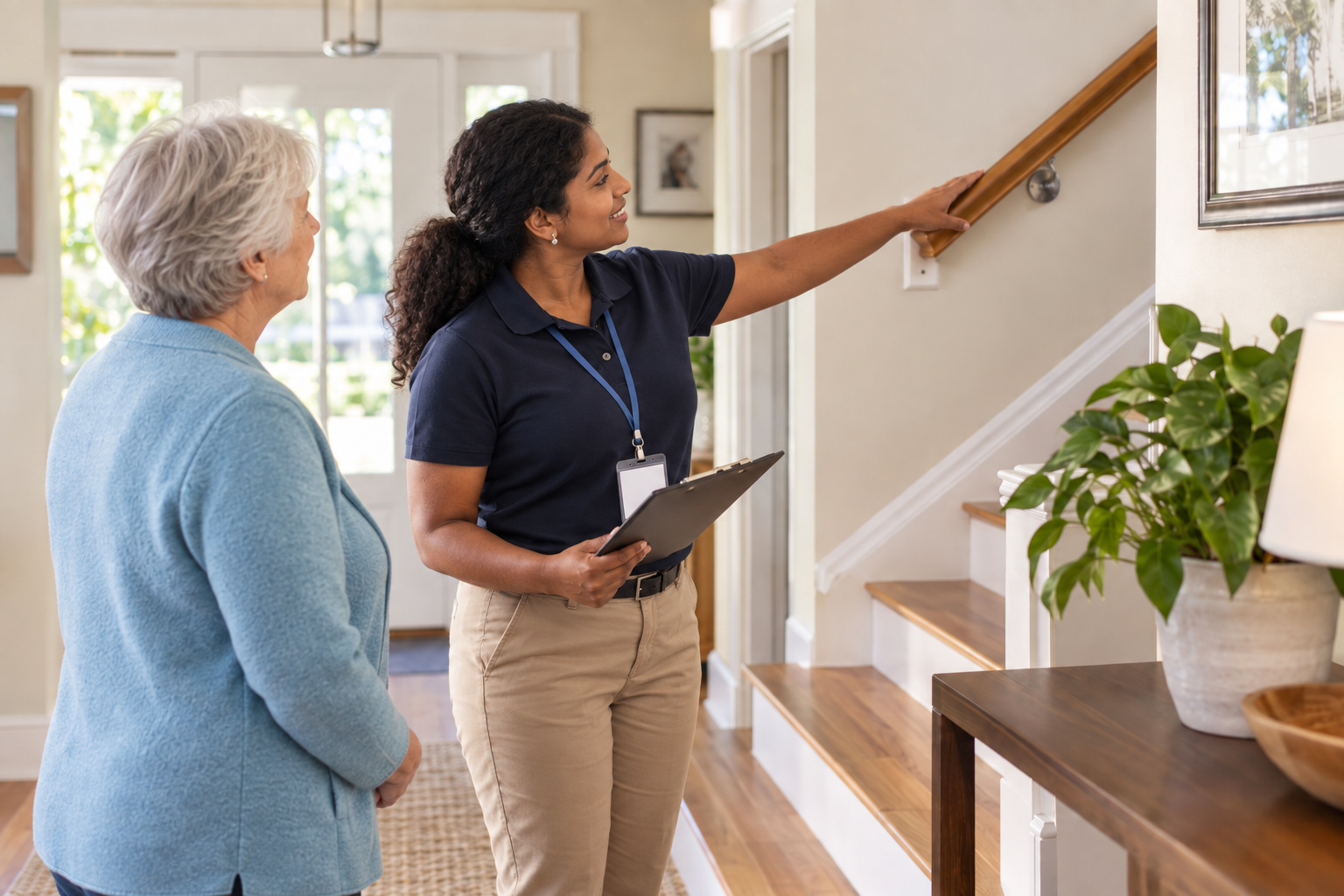
Home safety assessments can help identify risks that are easy to overlook when you are used to living in the same environment every day. Loose rugs, poor lighting, unsuitable handrails, bathroom hazards, awkward furniture layouts and difficult entrances can all affect how safely someone moves around the home.
A useful assessment should do more than produce a generic checklist. It should consider the rooms and routes that are actually used, identify the most important risks, and help distinguish simple changes from issues that need a contractor, licensed trade or clinical assessment.
May be suitable for
Someone who has fallen or nearly fallen, feels less confident moving around the home, is planning to age in place, or wants to identify practical safety improvements before problems become urgent.
Main options
Whole-home assessments, falls-focused assessments, and proactive aging-in-place reviews, ranging from self-guided checklists to professional in-home assessments.
Typical costs
Self-guided checklists are free. Many professional aging-in-place or home safety inspections cost around $200–$500, depending on the assessor, home size and report depth.
Possible help with costs
Original Medicare does not provide a general standalone home-safety-inspection benefit, but covered occupational therapy, some Medicare Advantage benefits, Medicaid services, VA care and local fall-prevention programs may help in qualifying circumstances.
Is it right for me? · Assessment types · What should be checked · What an assessment is · Costs · Funding · Choosing an assessor · Find providers
Is a home safety assessment right for me?
A home safety assessment may be useful when someone has fallen, had near-falls, become less confident moving around the home, or is planning ahead for changing mobility. It can help identify practical hazards before deciding which modifications or services are actually needed.
May be suitable if…
You are worried about falls, stairs or bathroom safety, someone has recently returned home after illness or injury, mobility is changing, a caregiver has noticed new risks, or you want to prepare the home for aging in place before problems become urgent.
Consider an occupational therapy assessment first if…
Transfers, cognition, wheelchair positioning, complex mobility, daily activities or caregiver assistance are central to the problem and the recommendations need to be closely matched to the individual’s functional abilities.
A general home safety assessment is primarily focused on hazards and the environment. An occupational therapy home assessment goes further by evaluating how the person’s abilities, health and daily activities interact with that environment.
What types of home safety assessment are available?
Home safety assessments can range from a simple self-guided room-by-room review to a detailed professional assessment with written recommendations. The right level depends on the risks involved and how complex the person’s needs are.
Whole-home safety assessment
A whole-home assessment reviews entrances, stairs, hallways, flooring, bathrooms, bedrooms, kitchens, living spaces and outdoor routes.
The assessor should identify hazards, explain why they matter and prioritize practical changes rather than simply listing every possible modification.
Falls-focused assessment
A falls-focused assessment may be appropriate after a fall, repeated near-falls or a noticeable loss of confidence moving around the home.
It can concentrate on walking routes, stairs, transfers, lighting, floor surfaces, bathrooms and the areas where falls or instability are most likely to occur.
Aging-in-place planning assessment
An aging-in-place assessment looks ahead as well as at current risks. It can help identify which parts of the home are likely to become difficult if mobility changes and distinguish improvements that can be made now from longer-term projects.
What should a home safety assessment check?
A useful assessment should review both the physical home and the way the person actually uses it. Hazards that matter in one household may be irrelevant in another, so the review should follow normal daily routes and activities.
Entrances and outdoor routes
Check steps, handrails, thresholds, paths, lighting, surface condition and weather-related risks around the main entrances.
Stairs and circulation
Review handrails, stair condition, hallways, clutter, flooring, rugs, cords and whether common walking routes remain clear.
Bathrooms and transfers
Check bath and shower access, toilet transfers, grab-bar needs, slip hazards, lighting and whether support is being taken from unsuitable fixtures.
Lighting and everyday spaces
Review bedrooms, kitchens and living areas for poor lighting, awkward furniture layouts, difficult reach, night-time routes and trip hazards.
The person using the home
Consider mobility aids, balance, transfers, caregiver assistance and the particular activities or routes that have become difficult.
What a home safety assessment does — and does not — replace
A home safety assessment focuses on practical hazards, accessibility and day-to-day use of the home. It is not the same as a structural property inspection, building-code inspection or medical evaluation.
A home safety assessment is not a building inspection or clinical assessment
A home inspector may focus on structural defects, electrical systems, plumbing or property condition. A home safety assessor is looking primarily at how safely and practically the environment can be used.
Likewise, a non-clinical home safety assessment does not replace evaluation by an occupational therapist, physical therapist, doctor or other health professional when health, cognition, transfers or complex mobility are central to the problem.
A good assessor should also recognize when the issue is outside their scope. Structural concerns may need an engineer or contractor, electrical issues may need a licensed electrician, and functional or clinical questions may need an occupational therapist or another health professional.
How much does a home safety assessment cost in 2026?
Home safety assessment pricing is less standardized than installation services because the scope can range from a checklist to a detailed professional report. Current 2026 market guidance puts many professional aging-in-place or home safety inspections around $200–$500.
| Assessment | Indicative 2026 cost | What may be included |
|---|---|---|
| Self-guided home safety checklist | Free | Room-by-room checklist completed by the resident, family or caregiver. |
| Basic professional home safety assessment | About $200–$350 | In-home walkthrough, hazard identification and verbal or basic written recommendations. |
| Comprehensive whole-home assessment | About $300–$500 | More detailed review, prioritized recommendations and a written report. |
| Specialist or clinically led assessment | Often higher; varies by provider and scope | More detailed evaluation of function, transfers, mobility, equipment or complex home-modification needs. |
| Follow-up or reassessment | Varies | Review after modifications or when the person’s needs change. |
Ask what the assessment actually includes
Two services called a “home safety assessment” may be very different. One may be a brief contractor walkthrough, while another includes measurements, photographs, a written report and prioritized recommendations.
Ask whether the fee includes the home visit, written report, follow-up discussion, travel, measurements and any return visit.
Check whether the assessment is independent
Some assessors also sell equipment, remodeling or installation services. That does not automatically make the assessment unsuitable, but you should know whether the recommendations are independent or connected to products or construction services the assessor provides.
Can Medicare, Medicaid or other programs help pay?
Funding depends on who performs the assessment, why it is needed and which program the person qualifies for. A privately arranged non-clinical safety inspection should not be assumed to be covered by Medicare or Medicaid.
Original Medicare and Medicare Advantage
Original Medicare does not provide a general standalone home-safety-inspection benefit. However, Medicare-covered home health services can include occupational therapy when the person meets the relevant eligibility conditions, including the need for qualifying skilled services and homebound status.
Medicare Advantage can be different. CMS guidance permits plans to offer an in-home safety assessment as a supplemental benefit in certain circumstances, focused on fall risk and prevention and performed by an occupational therapist or another qualified health professional. Actual benefits vary by plan.
Medicaid and Home and Community-Based Services
Medicaid programs can include occupational therapy, home health services and environmental or home-accessibility modifications, but the exact assessment and authorization routes vary substantially by state and program.
If a home safety assessment is needed to support a Medicaid-funded modification or care plan, contact the relevant state Medicaid or HCBS program before arranging a private assessment.
Help for veterans
VA services can include home safety evaluation as part of skilled home health and occupational therapy care for eligible Veterans. VA occupational therapy also includes home safety, accessibility, falls prevention and aging-in-place work.
Ask the Veteran’s VA care team whether a home safety evaluation or occupational therapy referral is appropriate and available locally.
State and local assistance
State and local fall-prevention, aging and home-modification programs may offer assessments directly or help people find suitable services.
The National Institute on Aging recommends checking the local health department, Eldercare Locator or Area Agency on Aging for home-modification and fall-prevention programs.
How to choose a home safety assessor
Look for someone who can explain what their assessment covers, what experience or training they have and whether their recommendations are independent. A useful assessment should identify priorities and recognize when another professional is needed.
- Relevant experience with older adults, falls, accessibility or aging-in-place homes.
- Clear explanation of what rooms and outdoor areas are included.
- Consideration of how the resident actually moves through and uses the home.
- A written, prioritized report rather than an unstructured list of products.
- Clear distinction between urgent risks and longer-term improvements.
- Transparency about whether the assessor also sells equipment or construction work.
- Ability to identify when OT, PT, medical, structural or licensed-trade input is required.
- Willingness to coordinate with family, caregivers or other professionals where appropriate.
- Clear information about fees, travel, reports and follow-up.
Credentials such as aging-in-place or home-safety training can be useful, but no single credential should substitute for checking the assessor’s actual scope, experience and independence.
FIND HELP NEAR YOU
Find home safety assessment providers that serve your area
A provider does not have to be the closest business to your home to serve your ZIP. AIPUSA uses declared service coverage to help identify providers that say they work in your area.
Choose Home Safety Assessments and enter your ZIP to search available providers.
Sources and review
Reviewed: September 2026
AIPUSA uses government, public-health and professional sources for home-safety and funding guidance, supplemented by current market sources for indicative pricing. Coverage, program eligibility, provider scope and prices can change. Check the relevant agency, health plan, state program and provider before arranging an assessment or relying on funding.
- CDC — STEADI Patient & Caregiver Resources
- CDC — Check for Safety Home Fall Prevention Checklist
- National Institute on Aging — Preventing Falls at Home: Room by Room
- National Institute on Aging — Home Safety Tips for Older Adults
- Administration for Community Living / Eldercare Locator — Modifying Your Home
- Medicare.gov — Home Health Services
- CMS — Medicare Advantage supplemental benefits guidance
- Medicaid.gov — Home and Community-Based Services
- VA — Skilled Home Health Care
- VA — Occupational Therapy
- Angi — Aging in Place Home Inspection cost guidance
- Age Safe America — home safety assessment pricing context