
ACCESSIBLE BATHROOM REMODELING
Accessible Bathroom Remodeling: Creating a Safer, Easier-to-Use Bathroom
Accessible bathroom remodeling can make bathing, using the toilet and moving safely around the bathroom easier. This guide explains shower and bathing options, layout and support changes, typical costs, possible funding routes and how to find providers who serve your area.
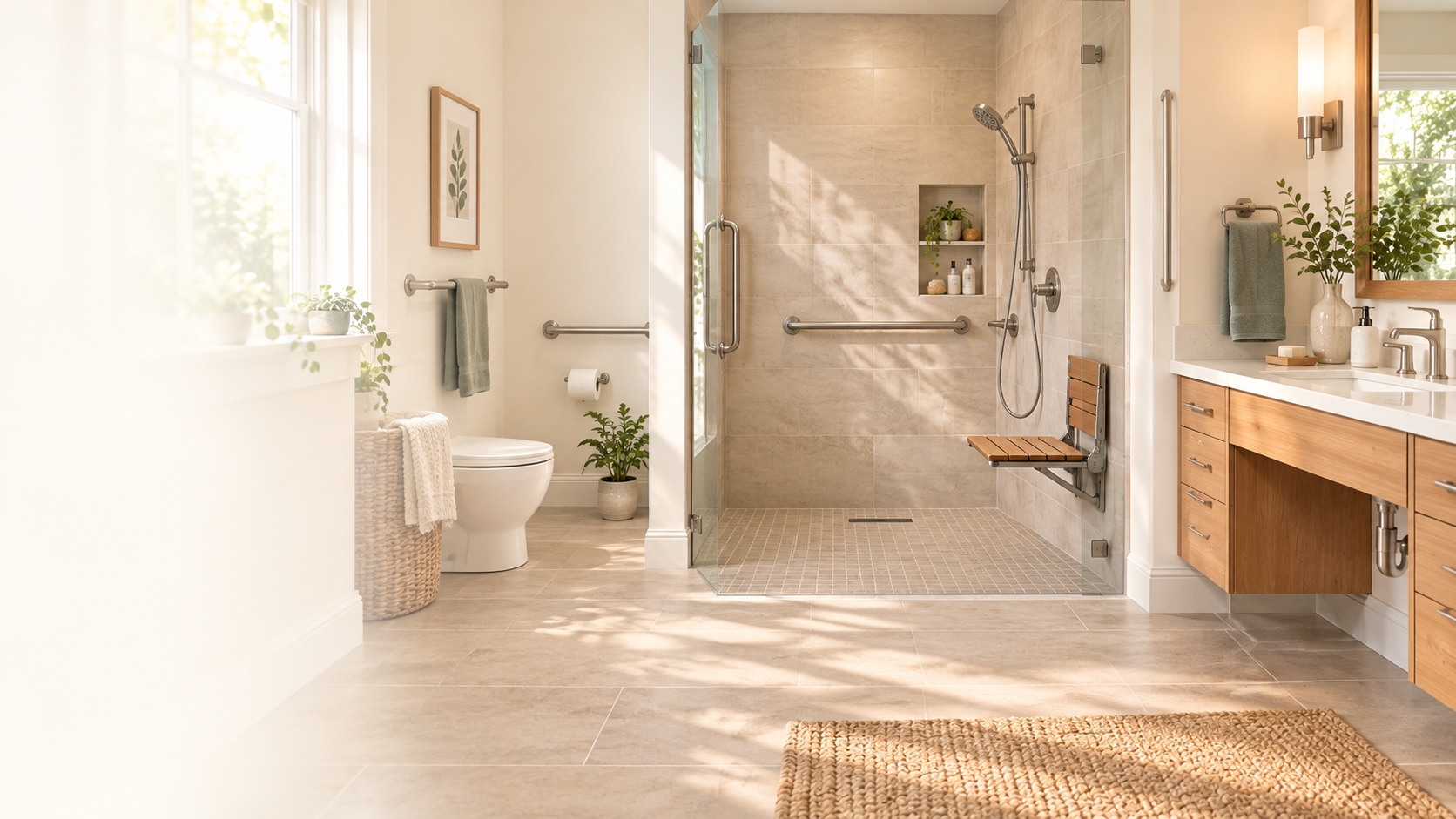
Bathrooms combine water, hard surfaces, transfers and relatively small spaces, so relatively modest changes can sometimes make a substantial difference to safety and independence. The right solution might be a lower-threshold shower, better support around the toilet, improved lighting and flooring, or a more extensive change to the room’s layout.
The best design depends on how the bathroom is actually used. Before committing to major building work, consider the person’s mobility, balance and transfer ability, any wheelchair or walker use, whether a caregiver provides assistance, and whether the proposed layout will continue to work if needs change.
Best for
Making bathing, using the toilet and movement around the bathroom safer or easier when mobility, balance or transfers have become difficult.
Main options
Low-threshold or roll-in showers, accessible bathing and transfer features, and wider whole-bathroom layout changes.
Typical cost
A broader accessible bathroom remodel commonly falls around $5,600–$12,000, although smaller changes can cost less and complex structural projects can cost considerably more.
Possible help with costs
Original Medicare generally does not fund home remodeling, but some Medicare Advantage, Medicaid, VA and state/local programs may help in qualifying circumstances.
On this pageIs it right for me?Bathroom optionsWhat to checkSafety & accessibilityCostsFundingChoosing a providerFind providers
Is accessible bathroom remodeling right for me?
Accessible bathroom remodeling may be worth considering when getting into or out of a bath or shower, using the toilet, reaching fixtures or moving around the room has become difficult or unsafe. The appropriate solution can range from a few targeted modifications to a substantial remodel.
Remodeling may help if…
You are stepping over a high tub or shower threshold, struggling to stand during bathing, finding toilet transfers difficult, relying on furniture or towel rails for support, having difficulty using the room with a walker or wheelchair, or planning ahead for changing mobility.
Consider an assessment first if…
It is unclear which modification will actually solve the problem, transfers require physical assistance, wheelchair positioning is difficult, balance or cognition is changing, or several parts of the home may need modification.
A home safety or occupational therapy assessment can help identify how the person’s abilities, activities and home environment interact before significant building work is commissioned.
What bathroom accessibility options are available?
Accessible bathroom remodeling does not necessarily mean rebuilding the entire room. The right scope depends on the barriers that need to be removed and how the bathroom is used now and in the future.
Low-threshold and roll-in showers
Replacing a high-sided tub or shower threshold can make the bathing area easier to enter. Depending on the user’s needs, this may involve a low-threshold or curbless shower, a roll-in configuration, seating, a handheld showerhead and controls that can be reached without unsafe stretching.
Drainage, waterproofing and floor slope are particularly important when a shower is made level or nearly level with the bathroom floor.
Accessible bathing and transfers
Some people still prefer or need a tub, while others need seated bathing or additional transfer space. The important question is not simply which fixture looks accessible, but whether the person can get into, use and leave it safely.
Consider seat height, transfer direction, support points, door or threshold design, caregiver access and how long the user may need to remain seated while filling or draining a tub.
Whole-bathroom accessibility
A broader remodel can address several barriers together. Changes may include toilet height and positioning, accessible sinks or vanities, greater knee and floor clearance, wider doorways, easier-to-use faucets and controls, wall reinforcement for support bars, improved lighting and more slip-resistant surfaces.
What should be checked before remodeling?
Before choosing products or accepting a remodeling quote, check how the person enters, moves through and uses the bathroom. A design that solves one barrier but creates another can be expensive to correct later.
Entry and movement
Check the doorway, approach to the bathroom, clear floor space and whether a walker or wheelchair can be positioned and turned where necessary.
Bathing and transfers
Consider how the user gets into and out of the bathing area, whether they stand or sit, where support is needed and whether caregiver assistance is required.
Support and structure
Identify where grab bars, seats or other supports may be needed and whether walls and fixing points can safely support them.
Surfaces, drainage and lighting
Review wet-area slip risk, shower thresholds, waterproofing, drainage, visibility and night-time lighting.
Fixtures and controls
Check toilet position and height, sink access, faucets, shower controls, storage and whether commonly used items can be reached safely.
Safety, accessibility and installation
A safer bathroom depends on the whole environment, not simply buying products labelled “accessible.” Secure installation, appropriate placement, waterproofing, drainage, structural support and local building requirements all matter.
A private home is not automatically subject to the ADA
ADA dimensions can provide useful design reference points, but most individually owned or leased private homes are not covered by the ADA. Do not assume a residential bathroom must be described as “ADA compliant” simply because it uses accessible features.
Other federal, state, local or housing requirements can apply in particular settings, including some multifamily, public or federally assisted housing. A remodeling provider should work to the building and accessibility requirements that actually apply to the property.
Support bars and shower seats need suitable fixing points; curbless showers need appropriate floor slope and waterproofing; plumbing or electrical changes may require permits or licensed trades. For a substantial project, ask the contractor who is responsible for these elements and for any required inspections.
How much does accessible bathroom remodeling cost in 2026?
Accessible bathroom costs vary considerably because the term can describe anything from installing support bars to moving plumbing and rebuilding the bathing area. Current 2026 market estimates put many broader accessible bathroom remodels around $5,600–$12,000, with projects outside that range depending on scope, location and structural work.
| Type | Indicative 2026 range | Why the price varies |
|---|---|---|
| Professional grab-bar installation | $200–$350 per bar | Wall type, reinforcement, number and position of bars. |
| Doorway widening | About $600–$2,000 for many projects | Load-bearing walls, utilities, framing, finishing and permits can raise costs substantially. |
| Roll-in shower | Around $2,900–$4,600 | Size, plumbing relocation, wall work, controls and finishes. |
| Walk-in shower | Around $6,000–$12,000 | Custom versus prefabricated construction, waterproofing, tile, glass and accessibility features. |
| Walk-in bathtub installation | Around $4,000–$15,000 | Tub type, plumbing/electrical work, site preparation and specialist features. |
| Broader accessible bathroom remodel | Often $5,600–$12,000 | Room size, demolition, plumbing, electrical work, structural changes, fixtures and finishes. |
Why quotes can vary so much
Moving a drain or toilet, changing walls, widening a doorway, correcting subfloor problems or creating a properly drained curbless shower can make a project considerably more involved than replacing fixtures in their existing positions.
Ask whether the quote includes demolition, disposal, waterproofing, plumbing, electrical work, structural reinforcement, permits, inspections, fixtures, finishing work and any work needed elsewhere in the room.
Compare the total installed project
Compare like with like. A lower fixture price does not necessarily mean a lower completed-project cost if plumbing, waterproofing, structural preparation or finishing work is excluded.
Can Medicare, Medicaid or other programs help pay?
Some programs can help with qualifying home accessibility modifications, but there is no single nationwide benefit that pays for every accessible bathroom remodel. Coverage depends on the program, the person’s eligibility and whether the proposed work meets that program’s rules.
Original Medicare and Medicare Advantage
Original Medicare generally does not pay for bathroom remodeling. CMS’s Durable Medical Equipment guidance does not generally cover common bathroom safety items such as grab bars and bathtub seats under the standard DME benefit.
Medicare Advantage can be different. Some plans may offer supplemental bathroom-safety benefits or related in-home support beyond Original Medicare. Benefits and eligibility vary by plan, so check the plan’s current Evidence of Coverage or contact the plan directly.
Medicaid and Home and Community-Based Services
Medicaid Home and Community-Based Services programs may cover qualifying home or environmental accessibility modifications when they are necessary to support safe community living.
Covered work, eligibility, spending limits, prior authorization and application routes vary by state and program.
Help for veterans
The VA Home Improvements and Structural Alterations (HISA) benefit can help qualifying Veterans and Servicemembers with medically necessary alterations to a primary residence. Relevant examples can include roll-in or barrier-free showers, converting a tub to a seated shower, widening doorways and improving access to bathroom sinks or counters.
VA currently lists lifetime HISA benefit limits of $6,800 for specified qualifying circumstances and $2,000 for other qualifying circumstances. HISA rules are specific, and some bathing products or spa-style alterations are excluded.
Separate SAH and SHA adapted-housing grants may be available to Veterans or Servicemembers with certain qualifying service-connected disabilities.
State and local assistance
Your state or local aging network may know about home-modification grants, repair programs, nonprofit assistance or other local support. The Administration for Community Living recommends contacting your Area Agency on Aging and provides the Eldercare Locator for finding local services.
HUD also funds the Older Adults Home Modification Program, but this is generally delivered through eligible organizations rather than operating as a simple direct federal remodeling grant for individual homeowners.
How to choose an accessible bathroom remodeling provider
Look for a provider who understands both bathroom construction and accessibility. A good proposal should explain not only what will be installed, but why the layout is appropriate, what preparation is required and exactly what the installed price includes.
- Experience completing accessible or aging-in-place bathroom projects.
- Ability to explain how the proposed design addresses the user’s actual mobility and transfer needs.
- Appropriate contractor licensing, permits and inspections where required locally.
- Clear responsibility for plumbing, electrical work, waterproofing and structural reinforcement.
- Willingness to work from recommendations made by an occupational therapist or home-safety professional where appropriate.
- An itemized installed quote stating what is included and excluded.
- Clear product, workmanship and waterproofing warranties.
- Realistic information about disruption, bathroom downtime and project timescale.
A Certified Aging-in-Place Specialist (CAPS) credential can be one useful sign of additional aging-in-place training, but it is not a substitute for checking the provider’s relevant experience, licensing, references and proposed scope of work.
FIND HELP NEAR YOU
Find bathroom remodeling providers that serve your area
A provider does not have to be the closest business to your home to serve your ZIP. AIPUSA uses declared service coverage to help identify providers that say they work in your area.
Choose Accessible Bathroom Remodeling and enter your ZIP to search available providers.
Sources and review
Reviewed: September 2026
AIPUSA uses primary government and professional sources for safety, accessibility and funding guidance, supplemented by current consumer-market sources for indicative pricing. Program eligibility, benefits, building requirements and prices can change. Check the relevant agency, plan, state program and local requirements before making financial or construction decisions.
- CDC — Older Adult Falls Data
- National Institute on Aging — home and fall safety
- U.S. Access Board — ADA Accessibility Standards
- Administration for Community Living — Staying in Your Home
- CMS / Medicare — Durable Medical Equipment guidance
- CMS — Medicare Advantage benefits
- Medicaid.gov — Home and Community-Based Services
- VA — Home Improvements and Structural Alterations (HISA)
- VA — SAH/SHA disability housing grants
- AOTA — Home Modifications
- NAHB — Certified Aging-in-Place Specialist (CAPS)
- Angi — bathroom remodeling cost
- HomeAdvisor — bathroom remodeling cost